Tuesday, May 29, 2007
19th-Century Document and 21st-Century Scripture
 II Nephi 2-4 Under a Faithful-Critical Lens
By [Flannel Christian]
May 2007
The Book of Mormon clearly reflects the language, values, perspectives and priorities of nineteenth-century North America, quite in contrast to those that the best scholarship in the area can reasonably ascribe to pre-Columbian Native Americans of ancient Hebrew descent. The historians’ compelling critique, placing the Book of Mormon’s origin and authorship in the hands of Joseph Smith, Jr., however, does not address the text’s status of scripture, nor the (prophetic) insight it casts on a formative stage of American Christianity. When lifting up the Book of Mormon as an historicized artifact of religious and revelatory significance, one must inform the proverbial left hand what the right hand is doing. History and faith work best together. The more we understand the historical situation and issues addressed by the Book of Mormon, the more revelatory the text can become.
It is in this spirit that I examine a sample text from the Book of Mormon. In the narrative context, the selection is just after the period of the migration of Lehi’s family to the Americas, and the initial struggle for safety and identity in the new world. I begin with an identification of clearly nineteenth-century elements in the text, both for the purpose of making clear the origin and nature of the text and for the purpose of beginning to lift up what might be most prophetic about the passage in its nineteenth-century context. Then, I attempt to draw conclusions about the motivations and insights of Joseph Smith for writing the text in such a way, and also touch on possible meaning for our world today.
This is not intended to be exhaustive, but introductory – to start and shape a conversation, not to end it. This project is also not meant as an apologetic – strictly a defense – of either the Book of Mormon or Joseph Smith’s character. The Book of Mormon is an historical artifact, and Smith was a human being – as such they have particular perspectives and priorities that may not necessarily be in common with our current sensibilities or best understanding. There are two lessons here: we must always be cognizant of the limitations and contextualized nature of our own consciousnesses and predispositions, and that God can (and must?) work through humans enmeshed in sin. The fact that we can imagine a vision radically different from what we have been given or have been in the past is the best proof I have seen of the existence and persistence of grace.
II Nephi 2 begins with a clear reference to Joseph Smith, Jr., and an endorsing overture to his career (vv10-35). Verse 29 expressly names Joseph Jr. in a prophecy outlining the forthcoming of the Book of Mormon (BofM). Although this arises toward the beginning of current versions of the BofM, in terms of the dictation timeline of the project by Joseph Smith to Oliver Cowdery it is near the end. [1] After encountering public resistance and scorn resulting from word of his “translation” work, it seems natural that Smith would want to authorize – if not divinize – his efforts. [2] II Nephi 2 does exactly that. [3] It might be a fantastically accurate (and coincidentally beneficial) ancient prediction, or convenient self-gratification on the part of the author. [4]
Verse 2:21 also answers the concerns of 19th-century Americans, particularly false doctrines and contention between/among Christians. [5] The use of the phrase “in the latter days” smacks of dispensationalism and the Second Great Awakening.
The obligation of God to respond to faith, in 2:42, where prophecy is the product of the prophet’s piety, also reflects 19th-century frontier American confidence in the power of the individual, and points at the larger confusion at the time between the roles of grace and works in salvation. In a post-revolutionary American context, the can-do and individualistic rhetoric of the Revolution has been translated into spirituality, reviving the ancient Christian question of how much individual behavior affects salvation. [6] In a Jewish worldview around 600 BCE [7], however, this is not a perspective likely to have surfaced. Prophets speak because God makes them, not because of anything particular the prophet did to make themselves deserving of God’s direction. God chose Abraham and Moses, not the other way round. In a Hebrew worldview at that time, God continues to be involved with the people of Israel because God is bound by a covenant, not because of the faith of the people – which many times lapsed and failed. Nevertheless God continued to be involved with and provide a prophetic voice for Israel. It seems clear that the language and worldview in the II Nephi text represents 19th-century American Christian presumptions, rather than 600 BCE Hebrew ones.
Another clue as to the 19th-century origin of the text is the already-fulfilled “prediction” that the ancestors of indigenous Americans (the Lamanites) would not “perish” (3:3&16). In fact, one of the background assumptions/purposes of the BofM is to explain the presence of indigenous peoples in the Americas and their relationship to ancient Hebrews.
Skepticism of the exclusively divine origin of the BofM is fueled by persistent parallels between Smith’s work and Ethan Smith’s 1823 book, A View of the Hebrews, which posited a Semitic origin for indigenous Americans. The book was in wide circulation in the years before Joseph Smith began working on the BofM, and several members of Oliver Cowdery’s family were members of Ethan Smith’s congregation in Poultney, Vermont. [8] As well as possibly providing the central thesis for the BofM (that is, the Semitic origin of Native Americans), A View of the Hebrews might have provided the broad plot outline for Joseph Smith’s work. [9] At any rate, the parallels between the two works are uncanny, if it is supposed to be mere coincidence. [10]
19th-century-isms continue in “Nephi’s Psalm” (3:29-66). First, the idea of the ministering of angels (3:39) is foreign to ancient Hebrew thought. In the Hebrew scriptures, angels do not “minister” to humans, but are merely agents of God’s will. The phrase “children of men”, an approximation of “son of man,” doesn’t show up in Jewish thought until the Maccabeean era and the composition of the book of Daniel. [11] Mention of the “evil one” (3:44) is also proleptic in that Hebrew thought up to the Babylonian exile hadn’t developed the idea of an evil adversary somehow explicitly opposed to YHWH. The passing reference to “salvation” (3:50) and “redemption” (3:51) is striking evidence of Christian influence. To have these phrases show up reveals a conflation of Biblical language accessible to the (nineteenth-century) author, and written into an ancient context. Additionally, an emphasis on contrition and heart-brokenness as a qualification for spiritual sincerity or an encounter with the Holy echoes strongly of conversion stories typical of the Second Great Awakening, the religious milieu in which Joseph Smith was raised. [12]
Most damning, perhaps, to the view of the BofM as an historical record of pre-Columbian indigenous Americans are the glaring archeological, anthropological and linguistic claims that are ruled out by virtually all scholarly research in those areas. The sudden and unexplained presence of domesticated livestock in the new world (4:16), the existence and use of a working compass (4:17), and the manufacture of iron, brass and steel (4:21) despite absolutely no archeological evidence of any metal-smithing technology among native American populations and the fact that steel itself would not be developed until the fourth century BCE on the Iberian peninsula.
Also troublesome to a “historical record” point of view are the presence of 19th-century ideas among 6th-century BCE peoples: proto-democratic political institutions (4:28, also Mos. 13:35-36) [13], racism based on skin color (rather than other cultural or ethnic identifiers) (4:35), ethnic mixing a problem (rather than religious diffusion) (4:37), identifying darker-skinned peoples with sloth and mischief (4:39), and so on. Certainly, elements of each of these can be found rising in isolation and rarely in the Biblical record. But their prevalence in the time and national culture of Joseph Smith, Jr., points to more than coincidence. [14]
The Book of Mormon’s “primary purpose was to warn Americans in the 1830’s.” [15] Like many books and fragments in the Bible [16], the Book of Mormon was written as if it were a record of an ancient age, but merely used that format to speak to the issues facing believers in that day. [17] In contrast to 20th-century ideas of authorship and honesty, ancient writers and thinkers both within and outside the Judeo-Christian community regularly wrote under assumed identities, for various reasons. [18] Pseudepigraphical works, or texts written under the name of another person, served to validate and promulgate ideas that might otherwise not as quickly or as authoritatively gain currency among readers. [19] It might also be the case that pseudepigraphical writers felt themselves to be faithfully continuing what they perceived to be the tradition or thoughts of the original figure, only recast for contemporary circumstances. Approaching the BofM as a pseudepigraphical work not only allows one to get past the historical inaccuracies and the threat of imposing upon indigenous American populations a history that is not their own (in a new variety of cultural colonialism), but opens up the text to be much more meaningful about our own history as inheritors of frontier American Protestant Christianity. [20]
Joseph Smith’s self-endorsement at the beginning of II Nephi 2 reflects an understandable human desire for acceptance and belief – to be believed, believed in, and have one’s insights taken seriously. It could be this underlying sentiment that drove the pseudepigraphical nature of the BofM’s authorship in the first place. After all, toward the time of the manuscript’s completion, and increasingly after its publication, Smith prophesied under his own name. Pseudepigraphy might also unconsciously reflect a sense of one’s own indebtedness to the influence and inspiration of the past, to engage oneself in faithfully carrying on the work of those who have gone before. Writing oneself into the narrative of the past – oftentimes done implicitly, done here by Smith explicitly – is also a way of framing ones life and actions as participating in a larger, longer, more noble and purpose-driven enterprise than the vain hopes and vision of one lonely person. [21] Writing oneself into the narratives of the past can serve to ground oneself in the tradition and values of the narrative, but it can also offer the dangerous impression that the authority of the tradition is at the whim of this latest participant. The project of the Book of Mormon may have started out being blessed by the former, and by the end shows influences of the corruption by the latter. Smith’s self-inclusion in the story of the Book of Mormon might serve as a representative tipping point between being formed by the tradition and seeking to command it – and as such can remain an object lesson of both the blessing and danger of seeing ourselves as continuing the path of history.
The anachronisms of Joseph Smith, grafting 19th-century cultural issues and presumptions like racism and democracy into the story of an ancient people, actually serve the argument that the BofM is a pseudepigraphical work of profound importance. [22] In seeing Smith’s authorship, we are provided the opportunity to see a daring human perspective, while recognizing ourselves that the perspective is human, and thus falls short of the glory of God. Letting go of the historical-record argument, we are liberated from worshipping the book, and instead can glean from the book the mind and will of God. The text can be turned upon itself in its yearning for justice in a world of unjust politics and religion, and speaks as much to the 21st-century as to the 19th in “offer[ing] ways of surviving in liberal society without being destroyed by its corrosive potential.” [23] Even if we no longer adopt the manifest-destiny perspective of “America for (White) Americans” implied by seeing this continent as a blessing set aside for colonial descendants, we can take up the hope resident in that affirmation. There is a unity of mind and purpose and history that awaits all people – indigenous and colonial, Christian and Jew, Old World and New World. The discord and contention that seemed to be ripping society apart in the early years of the nineteenth century are answered by a hope in peace and unity. These early years of the twenty-first century stand hardly less in need of that hope.
The portion under examination here also speaks of the fate of those who would plot division and warfare. Their war-mongering and violence cut them off from the presence of God (4:31-32). We in the 21st century are able to confront the issue of wars of/for power without taking up the racially-charged references that plagued the nineteenth century. (Or are we? These uncomfortable elements may be just that uncomfortable because of how closely they fall to our own national rhetoric regarding our would-be enemies. We may not have come so far in two-hundred years.) The BofM may speak of an ancient rivalry, but its insight remains all too compelling: those who sow violence (in opposition to God’s desire for peacefulness and unity) will be scourged to the point of destruction (4:41). Our nation and American Christian establishment would do well to listen to this prophetic critique, lifted earnestly out of the Biblical tradition. Not only is such violence and war-making contrary to right relationship with God, it leads to the destruction of democracy. The nineteenth-century threat was Jacksonianism. What is the 21st-century threat to democracy, and do its roots reach into war-making and power-hunger?
Nephi’s Psalm (3:29-66) echoes the perennial American issue of facing a terrible and powerful enemy armed with little more than hope in God. And yet, it is a song of praise for God’s constancy, and a hymn of confident hope that trusting in God is ultimately the wise choice. Nephi, like Joseph, is crying out for deliverance from his enemies, lashing out and asking God to wreak vengeance upon them. Even so, despite his heart filled with rancor and teeth set with venom, his prayer leads him in the end to seek something different. The challenge, as Nephi puts it, is to “ask not amiss” (4:65). We have to know what we’re asking for – not vengeance or victory or security; but love and forgiveness, release from anger and strength of heart. How much do American leaders need to pray this prayer of humility and awe, to sing this song seeking the strength to forgive, laying one’s weakness before God and putting trust in God’s commands? How many of our leaders need to ask not amiss – to ask the right question?
In the end, we must keep in mind about the Book of Mormon the kind of sensibility demonstrated by Nathan Hatch, in The Democratization of American Christianity:
…[T]he Book of Mormon is a document of profound social protest, an impassioned manifesto by a hostile outsider against the smug complacency of those in power and the reality of social distinctions based on wealth, class, and education. In attempting to define his alienation from the world around him, Smith resorted to a biblical frame of reference rather than to one of conventional politics…. Yet in constructing a grand and complex narrative account of the ancient world, he chose to employ a distinct set of biblical themes: divine judgment upon proud oppressors, blindness to those wise in their own eyes, mercy for the humble, and spiritual authority to the unlearned. This book is a stern and sober depiction of reality. [24]
By exposing the lie that the BofM is not an historical account of ancient peoples, we can see the truth it was crying out all along. By understanding what is fiction, we begin to identify the fact. The BofM isn’t something more than it is. It is, however, desperately more than the story of golden plates and peep stones. It is, at its heart, a sober and startling depiction of the reality young Joseph and so many others saw in the early years of the nineteenth century. The Book of Mormon was a truth-telling that ended up converting thousands, and giving them hope. That is still something we can touch today.
-----------------------------------------------
[1] Dan Vogel and Brent Lee Metcalfe, Eds., American Apocrypha: Essays on the Book of Mormon (Salt Lake City: Signature Books, 2002), 235-236; and Brent Lee Metcalfe, Ed., New Approaches to the Book of Mormon: Explanations in Critical Methodology (Salt Lake City: Signature Books, 1993), 398.
[2] Ibid., 249.
[3] Ibid., 259.
[4] The Book of Mormon narrative directs the translation of the plates as Smith’s primary duty. Similarly, in a contemporaneous revelation given in March, 1829, Smith is chastised by the Spirit and told that no other gift besides translation will be given him. (Book of Commandments,1833, IV:2) Interestingly, this revelation is later revised to allow for Smith being given additional gifts in the future. (Jerald & Sandra Tanner, Mormonism – Shadow or Reality? [1964], 72.) (See also Doctrine and Covenants 5:1d, and American Apocrypha 248-250 & 260.)
[5] Dan Vogel, Ed., The Word of God: Essays on Mormon Scripture (Salt Lake City: Signature Books, 1994), 91: “Smith’s opinions in the Book of Mormon promised to settle the doctrinal differences that divided Protestant America in the 1830s – to end religious confusion.”
[6] Dan Vogel and Brent Lee Metcalfe, American Apocrypha (Salt Lake City: Signature Books, 2002), 351: “…the Christology of divine triumphalism… has long reigned unopposed in optimistic, ‘can-do’ American Christianity….”
[7] Lehi’s family is allegedly Jewish, and the surrounding events of their departure from Jerusalem places their migration around the year 600 BCE. (Ruth Ann Wood, Ed., Survey of the Book of Mormon [Independence, MO: Community of Christ Temple School, 1996], 44.)
[8] B.H. Roberts, Studies of the Book of Mormon, 2nd Ed. (Salt Lake City: Signature Books, 1992), 27.
[9] Ibid., 160-161.
[10] Ibid., 323-344.
[11] “Throughout the book there is no usage of the messianic term ‘Son of Man,’ although this is the one that Christ usually identified with himself in his own ministry. The expectations of the Nephites are those of nineteenth-century American Protestants rather than of biblical Hebrews.” (Thomas F. O’Dea, The Mormons [Chicago: University of Chicago Press, 1957], 39-40.)
[12] Mark D. Thomas, Digging in Cumorah: Reclaiming the Book of Mormon Narratives (Salt Lake City: Signature Books, 1999), 128-135; also, B. H. Roberts, Studies of the Book of Mormon, 2nd Ed. (Salt Lake City: Signature Books, 1992), 287-308.
[13] Tomas F. O’Dea, The Mormons (Chicago: University of Chicago Press, 1957), 36.
[14] Dan Vogel, Ed., The Word of God: Essays on Mormon Scripture (Salt Lake City: Signature Books, 1994), 91-92.
[15] Nathan Bangs, The Life of Freeborn Garrettson (New York: J. Emory & B. Waugh, 1829), 29, 33, 48; quoted from Mark D. Thomas, Digging in Cumorah (Salt Lake City: Signature Books, 1999), 26.
[16] For example, the Book of Daniel, Paul’s Letter to the Ephesians, Deuteronomy, Job, Deutero- and Trito-Isaiah, and others.
[17] Dan Vogel and Brent Lee Metcalfe, Eds., American Apocrypha: Essays on the Book of Mormon (Salt Lake City: Signature Books, 2002), 3.
[18] Tony & Charmaine Chvala-Smith, in a lecture in “Community of Christ Theology,” a course in the Community of Christ Seminary, 5/22/2007.
[19] Dan Vogel and Brent Lee Metcalfe, Eds., American Apocrypha: Essays on the Book of Mormon (Salt Lake City: Signature Books, 2002), 339-340: “…[I]t is quite clear that the book as a whole fits very comfortably into that broad class of pseudepigrapha which seek, as late-comers, either official entry into the canon or similarly high credibility by using an ancient authority’s name.”
[20] A. Bruce Lindgren, “Sign or Scripture: Approaches to the Book of Mormon,” Dialogue Spring 1986: 74: “Scriptural status [or authority] does not rest upon questions of historicity. It is likely that significant portions of the Old Testament canon are not fully historical as they stand today. Others, such as the book of Job, may not be historical at all. Writings are scriptural because the church holds them as normative or authoritative.”
[21] Through these verses, the Book of Mormon “bridge[s] the gap between the Bible and the 1830’s readers’ personal histories, between ancient respected prophets and despised modern visionaries.” (Mark D. Thomas, Digging in Cumorah: Reclaiming Book of Mormon Narratives [Salt Lake City: Signature Books, 1999], 44.)
[22] “…[T]he Book of Mormon is a document of profound social protest, an impassioned manifesto by a hostile outsider against the smug complacency of those in power and the reality of social distinctions based on wealth, class and education.” (Nathan O. Hatch, The Democratization of American Christianity [Yale U.P., 1991], 115-6.)
[23] Dan Vogel, The Word of God: Essays on Mormon Scripture (Salt Lake City: Signature Books, 1994), 86.
[24] Nathan O. Hatch, The Democratization of American Christianity (New Haven: Yale U.P., 1989), 116.
Labels: CofChrist, Seminary Papers
Wednesday, October 12, 2005
A Prophetic People, FInally
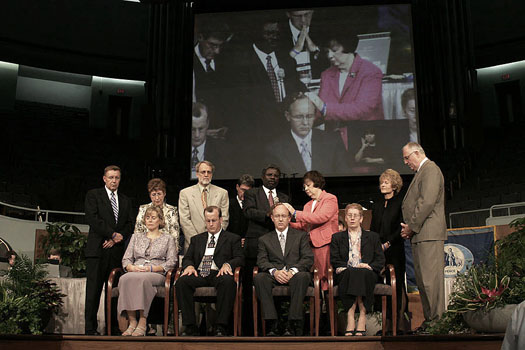
A Reflection on a World Conference Controversy
By [Flannel Christian]
This piece was published in the October 2005 issue of The Herald, the Community of Christ world church magazine.
One of the most amazing things at the recent World Conference was the membership’s response to become a prophetic church. What was viewed by some as discontent or lack of faith, seemed to me an inspiring testimony of our faith in the direction our community has set itself.
Typically, Christian churches consist of a progressive membership led by a conservative leadership. Our denomination has always been a peculiar exception, with a leadership so progressive we call it prophetic, struggling to challenge and inspire a dedicated and well-meaning but more conservative membership. It took us 124 years to officially recognize the ministry and priesthood role of women, and even then the church body was wrent with struggle. It has taken us decades of discussion to begin responding to the call to be a peace church, and there is still wide diversity of opinion on this issue.
At World Conference, in the Elders’ Quorum and the French-language Caucus, and even in the main chamber, the issue was raised that although each of the selected ordinands for the offices of Apostle and Bishop are able, spiritual and gifted individuals, one couldn’t help notice that as a group they were comprised of exclusively white North Americans with English as their primary language.
Two of the five were women – a fact that twenty years ago would have threatened quite a row. We could have conceivably congratulated ourselves for our growing (albeit belated and slow) representation of “both” genders in the Council of Twelve. How tremendously affirming that the gender of the individuals received little or no attention in the prayerful consideration and testimonies surrounding these calls. The Call set forth in Section 156, in this respect at least, we as a people have risen to meet. The painful, challenging, necessary prophetic leadership of the Presidency has moved our corporate worldview, and transformed our world. Just as it should.
Our forward-thinking leadership dragged our sluggish and resistant membership, but we eventually arrived. This World Conference showed me that we could respond to the prophetic call. But ours is not to merely respond to the prophetic call – we are called to be a prophetic people.
Peculiar amid our corporate history, the 2005 World Conference should be remembered for the daring, heartfelt, multiple voices from the floor of the chamber telling the leadership of the church not that they were being too progressive, but in fact that they were not being progressive enough. Nevermind the gender mix – where’s the diversity of nations, the variety of races, the breadth of languages, the assortment of cultures that our church body includes? We have taken the message of inclusion and representation and run with it – in the very best way.
What a wonder-filled witness to our community’s having taken hold of the call to be a world church, a peace church, a community of Christ. At every Conference the flags of the nations are unfurled to remind us that we are more than North Americans, or Westerners. And I can imagine this need to constantly remind us growing weary on our leadership. How tremendously encouraging it must have been to them that in the midst of the ceremony and structure a few courageous and concerned people stood to remind them.
Whether our leadership needed reminding is not the point – we’re all human and things are rarely as simple as they seem on the surface. But just the fact that the faithful had held the prophetic call so close to their hearts that they could not refrain from posing the difficult question – that is what I will remember.
It was one of those moments that fills my soul with confidence and hope – with this kind of spirit we really could build Zion. Among those first steps on Zion’s road is not just responding to the prophetic call, but being it for the world… and sometimes each other.
Labels: Authored Articles, CofChrist
Wednesday, November 17, 2004
The Lion and the Lamb--Poached and Fried?

The following is a working draft of an article attempting to express my belief that Christianity has less to do with Jesus being God and more to do with real-world actions that destroy or create Zionic conditions. "Zion" is Restoration-speak for what most Christians call the kingdom of God--that climate of relationships that is hinted at in Isaiah when he writes of the Lion and the Lamb laying down together, with a little child to lead them. How many of our actions are metaphorically and literally putting to death that possibility? I really want to ask:
Can there be Zion if the lamb was last-night’s veal and the lion is extinct?
By [Flannel Christian]
Seattle, WA
Undeniably, the need and fundamental call of the Restoration is to create Zionic conditions right now. If there is any common thread throughout our varied, complex, contradictory and often controversial history, it is the committed understanding that Zion must be built in this world by human hands guided by a faith that calls them to more than this world alone can inspire them to be. Our very use of the word “faith” in a Restoration context is not a thing-to-be-had but more fitting the prophetic tradition of loyalty to a principle. Our guiding principle—the object that has held our communal vision and enduring loyalty—has been articulated in the Book of Mormon and Isaiah scripture describing the changed relations of a Christ-like world: enemies become friends, oppressors and oppressed become equal, poverty and exploitation are extinguished, riches are shared by all, and there is even time to rest and enjoy the bounty that is Life. Whether we call it Joy, Hope, Love or Peace, what we’ve been talking about for the last 170 years is Zion, the kingdom of God, this brave, new world or undiscovered country where somehow the divisions and cruelties that plague us have been overcome.
What has changed through the years is our notion of how Zion will come about. It seemed that our rhetoric has always been at odds with our actions. In the early years in Kirtland, Independence and Nauvoo we spoke of Zion being established by God at some future (though imminent) date, but we worked to transform our lives and world right then to create Zionic conditions immediately. Over time, somehow, we began to speak more of this emboldening need to create (not just foster) Zionic conditions in the real world—both immediate and distant—but our individual and collective actions spoke more to the assumption that the work was really God’s to do, and that ultimately our hopes rested in some miraculous (and effortless?) transformation in the future.
As a community, we stepped back from the pressing questions of our time. Until recently, we haven’t engaged in supporting organized labor, resisting war and militarism, advocating for social services, working to limit (or even abolish) exploitation of people or the environment by the rule of profit, looking as a Community to combat the causes (not just the effects) of homelessness, hunger and poverty, explicitly calling out the un-Christian rhetoric of war-making, state-terrorism and the voracious mechanisms that undergird and are fed by it. Somewhere along the line we lost the impatience at the world failing to transform itself, and the gumption to transform it ourselves.
It seems we built the Temple just in time, and before we really realized what we were doing—answering a Call before we truly understood the scope of what we were dedicating ourselves to. But that’s the way God works—Love traps us into loving before we know everything, commits us to caring before we know how taxing that care and commitment will be. Like baptism or marriage or a new job, we commit ourselves and are called to do far more than we bargained for, and that is the true and lasting test of our faith. To what and how much are we willing to be committed?
It is very easy to sing hymns of peace in peace-time. How much more difficult is it to purposefully sing them when all around us are beating the drums of war? It is easy to stand by the right of people to health care when they’re healthy—but how much more difficult and costly is it to uphold that belief when affordable medicine and care is scarce? It is easy to support the environment in abstract—but how much more difficult when we must recognize our consumption demands are nurturing the destruction of our planet and entire nations with resources necessitated by our habits? It is easy to describe someone as evil—but how much more difficult to see how our own actions have contributed to that evil, and how the responsibility for both that someone and that evil rests in great measure with us? It is easy, in short, to smile and sigh at the vision of the Lion and the Lamb sitting together in the idyllic and far-off future—but how much more difficult is it to see our actions today as preventing or even destroying the possibilities of that vision to be realized? No one—least of all Jesus—said building Zion would be easy or convenient. But it is at the point at which it becomes inconvenient that it is supremely essential.
The Passion of Jesus serves this point excellently. It seems to me that the long, tortuous depiction of the terrible suffering of Jesus at the end of his life signals the depth of his commitment. It is difficult to imagine many ways in which his commitment to Peace and Love, and to ending exploitation, poverty and hunger could get less convenient or more uncomfortable at that point. He was humiliated, imprisoned, beaten, tortured, and painfully executed, and he could have ended it at any moment by simply recanting his words. Jesus could have shrugged and given in to the Empire at any second, and he would have been set free immediately. In fact, he wouldn’t even have had to assert anything at all—he could have gotten off with simply denying the accusations of his enemies. He surely knew what was in store for him if he didn’t! And yet, when the tire hit the road, when given the choice between fudging his commitment to really building the kingdom of God on earth and surviving on the one hand and remaining faithful to his vision of the possibility of people to live without fear or hunger or poverty and dying a cruel, prolonged death on the other hand, he still chose the latter.
How tremendously inspiring is that? The man we lift up above all others chose at the time of greatest peril to keep faith with Love and Peace. How empowered ought we feel as followers in that tradition to resist our own nation’s or culture’s or community’s march to war and vengeance and violence (no matter how dressed up in “patriotism” or “liberation” or “defense” it might be)? We truly should be at the forefront of those organizations working for Peace.
I am reminded of ________ who said you don’t realize your freedom until someone takes it away, and the degree to which to resist is the degree to which you were free. We don’t realize our commitment to Zion until the conditions of our world begin to make that commitment difficult, and the degree to which we resist is the degree to which we were working for Zion in the first place.
Everyday we are presented with opportunities—millions of times, often even without our awareness of it—to either resist or acquiesce to systems of violence and exploitation. That’s how they get us—the choices are so small we don’t think twice about making them, and so responsibility and impact is spread out, diffused, camoflauged. Oftentimes it is a choice of convenience or comfort, or the issue is muddied by self-interest or noble rhetoric. (Should I drive to the grocery store or walk? Buy the more-expensive fair-trade coffee or the discount brand? Should I vote for a tax levy for schools that my kids won’t go to? Should I spend my Saturday on a picket line for workers I don’t know?) But I think, for the most part, if we sounded those choices off the foundation that Jesus laid for us, it seems pretty clear which we ought to choose. That isn’t to say it’s easy—who has extra coffee money or a free Saturday—but that the decision is important.
Everyday we can in a thousand ways both subtle and overt contribute to or work against the creation of Zionic conditions. The choice between Zion and damnation isn’t made once-and-for-all, but every moment in a hundred little choices that act as votes and pavement for one or the other. Whether it be the environment, resources, weapons, militarism, war, wages, working conditions, hunger, homelessness, poverty, wealth, the shows we watch (if we watch TV at all) or the toys we buy our children, the choices we are given are small but essential, and ultimately almost all of them impact whether or not we have any lions or lambs left in the world, let alone little children who can lead them.
Labels: Authored Articles, CofChrist
Preaching with Scripture in a Post-Modern World

The following is an article I wrote partly in response to the material provided in the Elder's Temple School course packet, and partly to articulate to others what I have found helpful in writing and presenting my sermons over the past couple of years. It is presently slated to be printed in the March issue of the Herald.
Revolutions of the Word
Preaching with Scripture in a Post-modern World
By [Flannel Christian]
Somebody, somewhere must have been the first one to come up with the “Golden Rule”: treat others the way you want to be treated. Passé now, hearing it for the very first time it must’ve been shocking. To hear something so unexpected, and at the same time so inspiringly common-sensical, must’ve been a tremendous paradigm-shift, one of those memorable moments when one can actually feel their whole world-view change. Today, we call those “aha moments” or “mountaintop experiences,” but we hardly ever feel them in relationship to our scripture stories anymore.
One thing I think we forget about scripture is that when these now-immortal stories and statements were first made they were fresh, surprising and new, and yet held a common-sense quality that transformed and reoriented their listeners. Over the centuries of re-telling, our scripture stories have too often become old, tired and flat—we all know the lessons we’re supposed to get from a given passage; we know the characters and what they represent; we know practically everything there is to know about the story-line. There’s only so many ways to tell the story of Abraham and Isaac or Lot’s Wife or the Sermon on the Mount; only so many times you can hear it before you stop listening.
The richness and texture of those words and ideas have through the years been flattened out to cliché, shallow Sunday-school morals. This doesn’t make the prophets’ or Jesus’ message any less compelling or difficult to emulate—but it does make it less interesting to listen to, and for a speaker in the 21st century there are few curses worse than inattention.
We live, work, play and preach in a post-modern world, so it might seem natural to garner some lessons from our world and time in order to more dynamically engage it, to speak to it more creatively, to be listened to and have our words bear meaning in the minds, hearts and lives of our congregants. I find a lot to be gained by a closer examination of post-modern philosophy and literary analysis—people who are actively employed in developing new, fruitful and fascinating ways of looking at our history, traditions, politics, sexuality, science and scripture.
Jacques Derrida, a contemporary French thinker, coined the word “deconstruction” to describe his method of literary exegesis. Deconstruction examines a text by first considering the motives underlying the telling of the story, by asking questions such as who stands to gain from the telling of the story this way and are there other ways this story might be told. Then deconstructionists look for evidence of these other perspectives within the text, stories within the story, perspectives and ideas hinted at but never fully revealed, elements that become emphasized by their very lack of emphasis.
We see this sort of sophisticated, nuanced look at things even in the recent political climate—when candidates, journalists and ordinary citizens start considering not just what is said but what isn’t said, what is left out or smoothed over, and asking why that is the case; looking at who stands to gain from a lack of emphasis or from our forgetfulness. What facts or whose stories aren’t being told? Our people understand that what is being said tells us a great deal, but what isn’t explicitly expressed may tell us crucially more. Our world is a post-modern world, we’re getting better at reading “between the lines” (and above and below them) and we can use these tools to turn toward our own traditions and texts as well.
Deconstruction is a process of seeking out these stray threads, untold stories, unconsidered perspectives, implications and underlying assumptions, and teasing them out of the text. Through this we find a multitude of unforeseen elements—entire lives and hopes and dreams that were lost in the traditional reading. And although Derrida certainly believes story-telling is always story-creating, I’d argue that part of deconstruction is the ability to see the lie.
Of course, every story is a lie—it selects and omits, emphasizes certain elements and neglects others, chooses a perspective and assumes to some degree that that single perspective is objective. One distinguishing characteristic of post-modern writing—and we see it in contemporary novels all the time—is the narrator’s knowledge of her own perspective as peculiar, particular. We’re turned off by figures that speak as if their understanding is the truth, and admire the humility of someone willing to admit and even explore the limitations of their own experience and reflection. This is even more the case in devotional settings like worship and intimate conversation.
And, of course, saying that stories are lies is itself a lie, too. Stories and statements often express something very true, which is why we listen to them and how we judge them. What powers are served by believing that any story is a lie? What are the underlying assumptions of such a claim? Post-modernism habitually turns its own lens back on itself and finds the answers no less interesting.
Recognizing scripture as lies about some things in order to express truths about others opens up virtually infinite possibilities for what we can find—and challenges us to retell the story from another perspective, search for another meaning to tease, always aware that the final test is one of truth.
A deconstruction of Biblical stories turns them on their heads, shakes them up, mixes them around, and sees what comes up—waits to see if some new, unexpected and fruitful meaning arises from the ashes.
Abraham and Isaac: An Example
An easy way to start this is to take a Bible passage or story that has seemingly absolutely nothing to do with the topic of a sermon and eliminate the traditional conclusion from consideration. Let’s take the story of Abraham and Isaac: traditionally it’s about faith and obedience, particularly Abraham’s faith in God and willingness to do whatever God wanted him to do despite whatever personal or moral reservations he had. So, if we say the story cannot be anything about how good faith and obedience to God are, what is left? What other feelings or emotions or thoughts rise up out of the story?
If nothing comes to mind, another tack is to—just for fun—take the complete opposite position and see if there isn’t anything in the story that would support it. For example, let’s say that the story of Abraham and Isaac is really about how bad faith and obedience to God are. Abraham very nearly kills his son, after all, and if we believe our God is a loving God, that’s not a very good thing to do. We wouldn’t want any of our parents thinking they had to obey some voice in their head that was telling them to kill us—or you parents among us, if you felt God calling you to “sacrifice” your child, would you? Certainly not! There must be something else going on in the story.
Abraham must have misunderstood, but what? God says “I want you to sacrifice your son to me”—seems pretty clear. All of a sudden we start to feel what Abraham felt—confusion, doubt, searching for meaning. Did he misunderstand? What else could that mean? At the same time, there’s this big need to just obey. When we’re told by powerful figures to do something, even if we doubt that it’s the best thing to do, we’re more apt to do it—we believe with power comes knowledge, with information comes wisdom. So despite all our doubts and misgivings we, too, march Isaac into the desert. We tie him up and raise the blade and then…. Flash to God’s perspective now.
Does God want this to happen? Is God seeing this? What is God thinking?
We know God doesn’t want this to happen—we can feel that. And God obviously shows up at the last minute, so we know God is there at least by then. What is God thinking, though? What are we feeling, in God’s shoes? We’re horrified at what we’re seeing! We don’t understand Abraham—he’s going to kill his son! Is he crazy? So we run into the scene and with God’s hand stay Abraham’s arm—what do we say? “You misunderstood.” We can hardly believe it ourselves.
“But you told me to make Isaac’s life a sacrifice,” pleads Abraham, crying.
God says, “I told you to make his life a sacrifice, not to sacrifice his life!” *click!* God continues: “I wanted you and your son to dedicate your lives to me, do my work, love my people, care for my earth—make your living a sacrifice to me. I never wanted you to sacrifice your son’s life! That’s crazy!”
All of a sudden the traditional reading of Abraham is tossed upside-down. What was valuable in the old story is scorned in the new. The old story lifted up obedience; the new lifts up love as the highest value. Instead of a fickle, violent God, we are offered a loving God whose message was misinterpreted as a call to arms. In the instant that it takes to discover a new meaning for an old story, an entire worldview has changed. What’s more, you have a clincher for that sermon. This time people are going to listen.
When Bible stories were first told, they were this engaging, this frightening, this surprising, this transformative. They weren’t meant just to guide people, but to change them, to keep them thinking for days afterward about the story and their own journey through it.
For all the criticism that our contemporary culture receives (much of it deserved) with attention spans shortening and critical thought only palatable when packaged as entertainment, I think these qualities of life in the post-modern world can prove to be our allies, instead of our enemies, in scriptural preaching. We need to be woken up, have our cages rattled, have our hearts and minds opened to new meanings, our eyes opened to new places where the Holy resides.
If we can breathe new life into our tired old stories, we may do more than capture the attention of our congregants. We may discover a new world.
Labels: Authored Articles, CofChrist
